ChatGPT
 Perplexity
 Claude
 Google AI
 Grok
Grok
Summarize this article with an AI assistant.
How to Optimize Your Google My Business for AI Search Results
The way people find shops near them has completely changed. In 2026, customers aren't just scrolling through links on Google. They are asking full questions to an AI-powered search like Gemini or ChatGPT. According to studies, over 50% of local stores now track AI traffic because these smart systems read business listings to give answers instantly. If your shop isn't ready for this shift, you are missing out on major foot traffic.
In this blog, we will take a look at how to use generative engine optimization (GEO) to keep your store on top of search results, and how experts like Gonukkad can help you with their AI-powered GMB optimization services.
Key Takeaways
- AI needs natural, complete question-and-answer formats, not just a bunch of random keywords put together.
- If your open hours or address differ across the web, AI engines will flag your business as risky and hide you.
- Posting fresh updates twice a month tells the algorithms that your business is open, healthy, and highly relevant.
- Detailed reviews with specific product names help AI systems recommend your business for exact niche searches.
- Local SEO experts like Gonukkad provide dedicated GMB optimization to keep your store at the top of Google Maps seamlessly.
How is AI Actually Affecting Google Business Profile
AI isn't replacing your Google Business Profile (GBP)—it’s turning it into a primary data source. Traditional search looked for exact phrase matches. Today’s AI-driven engines look for topical authority and deep context.
Instead of just showing a map, the AI reads your entire profile, combines it with customer reviews, and summarizes why your shop is the best fit for the user's specific intent.
Related: Business Growth Framework: Build A Scalable Company From Day One
5 Shifts Happening Right Now in Local Search
- Conversational queries win: People type or speak full sentences like "Where can I get quick brake repairs under ₹2,000?" instead of typing "mechanic Delhi".
- Context over keywords: The system looks for deep meaning and semantic relationships across your profile data rather than checking if you repeated a keyword ten times.
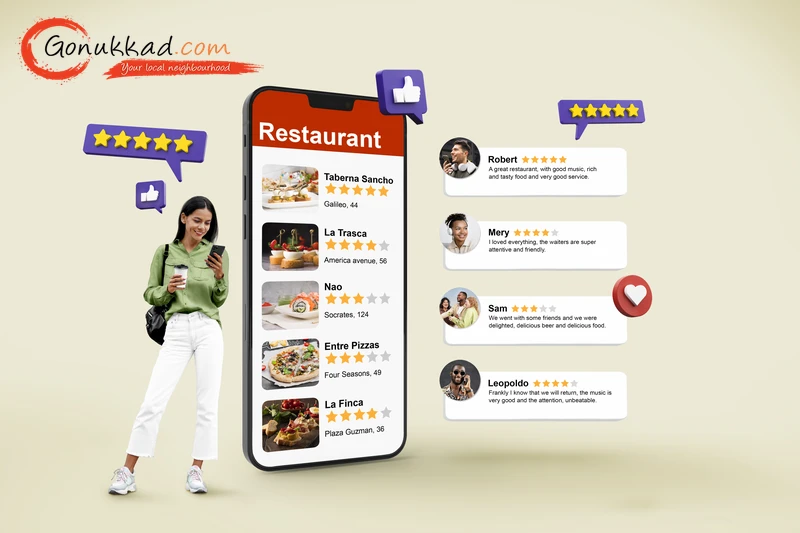
- Sentiment analysis of reviews: AI reads the emotional tone of your customer feedback to judge if your business is genuinely reliable.
- Hyper-localized matching: Results are narrowed down to a highly specific geographical footprint based on real-world entity verification.
- Direct interactions scale up: AI prioritizes profiles where users can book an appointment, view a live menu, or ask a direct question without leaving the search screen.
How Do AI Search Engines “Read” Your GMB Profile
To master AI search optimization, you need to understand how the crawler treats your dashboard. Think of it like an open-book exam where the AI is looking for specific structured data to feed its generative summaries.
1. Primary and Additional Categories
Your Primary Category is the single biggest signal you can give. If you run a premium bakery, don’t just settle for "Restaurant."
Set your primary category as "Bakery" and use secondary options like "Cake Shop" or "Pastry Shop." AI uses these tiers to establish your core topical authority.
2. NAP and Opening Hours
NAP stands for Name, Address, and Phone number. If your listing says you close at 8:00 PM but your website or Facebook page says 9:00 PM, the AI gets confused. When AI gets confused, it drops your visibility to protect the user experience.
3. Business Description
Write a highly clear, engaging description explaining exactly what you do, who you serve, and your specific location details. Avoid robotic sentences and keep it flowing like a real human explaining their product.
4. Service List with Descriptions
Instead of simply mentioning "Plumbing," provide specific services such as "Emergency Pipe Repair," "Water Heater Installation," or "Clogged Drain Cleaning."
Include a short 2-3 sentence description for each service. It ensures that clear text strings are available for AI to reference when someone seeks a precise solution.
5. Attributes and Products
Are you a clothing store that offers "In-store pickup"? Is your café "Wheelchair accessible" or "Pet-friendly"?
These clickable attribute chips inside your dashboard are instant filters for AI models tailoring answers to highly specific user needs.
6. Photos and Vision AI
Google uses highly advanced image recognition software to look inside your uploaded photos. If you upload clean pictures of a pizza oven, the system instantly logs that your restaurant makes authentic, fire-baked pizzas even if you forgot to type it in your description.
7. Posts (What’s New, Offers, Events)
Think of Google Posts as your business micro-blog. Regular posts show the algorithm that you are open and actively engaged. Sharing a seasonal deal or announcing a new arrival signals an active operational footprint.
8. Reviews (Detailed and Specific)
The modern algorithm scans your reviews for specific nouns and adjectives. A review saying, "Great service" is okay.
But a review saying, "The customized wedding lehenga I bought from this store in Chandni Chowk fit perfectly" is gold for generative engine optimization.
Related: How to Verify My Business on Google: Ultimate Guide
How to Optimize Your GBP for AI Search Results
To optimize your Google Business Profile (GBP) for AI-generated search results, you must shift focus from simply stuffing keywords to answering specific, conversational queries. AI systems pull from authoritative, highly specific, and active profiles to summarize answers for users.
1. Answer "People Also Ask" Questions
AI searches prioritize profiles that directly answer the "who, what, when, where, and why". Populate the Q&A section of your profile by proactively listing and answering common customer queries. Ensure your website's FAQ pages provide concise, clear answers that Google's AI can readily scrape.
2. Leverage Custom AI Services and Categories
Choose your Primary Category accurately, as it acts as a primary trust signal for AI. Select highly specific Secondary Categories that align with your exact niche. Add custom services to your profile, using descriptive language outlining your exact offerings to be favored by search bots.
3. Provide Clear Attributes and Features
AI search aggressively uses specific attributes to match user intent. Fill out every relevant attribute for your business in your profile dashboard. If you need help structuring this perfectly, teaming up with local experts like Gonukkad can ensure no important attribute or optimization setting is left blank.
4. Maintain an "Always-On" Profile
AI models favor businesses that prove they are active and reliable. Post Google Updates and Offers at least twice a month to signal ongoing activity. Regularly upload high-quality, geo-tagged photos and short videos, which help AI recognize your physical operating footprint.
5. Gather and Respond to Reviews
Reviews are necessary trust and credibility signals for AI algorithms. Encourage satisfied customers to leave detailed reviews containing location and service keywords. Respond to every single review professionally, using localized and relevant keywords naturally to show both users and machines that you are responsive.
Related: Why Is My Service Area Business Not Showing Up On Google?
Conclusion
Optimizing for AI search is simply about being accurate, clear, and active online. Keep your information updated, ask for great reviews, and let the technology work for you. If you want to save time and get more store visits, calls, or bookings, let Gonukkad handle your local SEO and GMB optimization to make your storefront a top spot on Google Maps.
Q. What is the main difference between SEO and GEO optimization?
A. SEO ranks standard website links, while SEO optimization helps your business details get chosen and summarized inside AI chat answers.
Q. Why did my shop ranking drop if my information is correct?
A. Your competitors are likely updating their profiles more often and getting much more detailed customer reviews than you.
Q. Can I use AI to write my entire business profile?
A. It is better to write it yourself because automated text often sounds stiff and lacks the real local feel that builds customer trust.
Q. How often should I add new photos to my listing?
A. Try to upload 2 or 3 clean photos of your real stock or store every single week to keep the algorithm happy.
Q. Do negative reviews completely block me from AI search?
A. No, as long as you reply politely and solve the customer's issue, the AI sees you as an honest, active business.
Supercharge your Business:
Go from surviving to tdriving!
Amplify sales witd our expert account management. Unleash your true potential now!
Call Us